Brandon scrap yard part of global supply chain
Would anyone have guessed that the junk that is collected all over Manitoba wound up as pieces in the reconstructed World Trade Centre, or France’s national monument?
Local scrap metal from Westman finds its way around the world in a fascinating process that begins with about 100,000 pounds of material shipped on an average business day from a scrap metal yard south of Brandon.
The yard, called 2 & 10 Metal Recycling, is in the business of recycling junk. The business depends on a constant stream of material rolling in and out its doors, the owner said.
“You got to ship a certain amount every day to keep the bills paid,” owner Jason Flikweert said. “And the yard would fill up pretty quick if you didn’t ship stuff out.”
The metal recycling business on the side of Highway 10, built from several piles of dirty, dusty and jagged pieces stacked roughly thirty feet high, might look like a equipment graveyard, but the opposite is true.
The scrap yard is constantly in flux. It diminishes and replenishes its piles as it does business. The public brings in about 33,000 pounds of scrap metal on the average day, and the business searches Westman for even more, Flikweert said.
Local, independent, in-depth.
Our Prairie stories.
When old things in Westman break down for good, like farm equipment, or stoves, or vehicles, they become a problem for whoever owns them. They need to go somewhere, simply so that waste doesn’t pile up and decay.
The scrap yard enters as an intermediary. It buys junk metal from customers, and then processes it south of Brandon and sells the product as bulk metal to a steel mill out of Selkirk. Flikweert said this is a crucial job to be done.
“It’s definitely 100 per cent necessary,” Flickweert said. “Cleaning up the countryside; instead of digging a hole and burying it, better to get some use out of it than wasting a valuable product.”
Metal that moves through 2 & 10 Metal Recycling is on its way to be reborn, despite the appearance of a junk graveyard. The local scrap yard is a part of a production chain where old metal is recycled.
The scrap yard prepares metal and ships it to a steel mill in Selkirk, called the Gerdau Steel Mill. The junk metal is melted down into molten steel, and then recast as new products that wind up in projects all over the world — most notably perhaps, in Paris and New York City.
“You can find Gerdau Manitoba elevator guide rails in iconic structures such as the Eiffel Tower and many of the tallest buildings in the world, including One World Trade Center,” said Bryce Riou, marketing manager at Gerdau North America, in an emailed statement to the Sun. “Our steel uses 96 per cent recycled content from supplier partners like 2 & 10.”
Would anyone have guessed that the junk that is collected all over Manitoba wound up as pieces in the reconstructed World Trade Centre, or France’s national monument?
The neat fact behind this is that steel and aluminum metals are, in effect, endlessly recyclable. They can be melted down and recast as new items over and over again without losing strength. As a result, it is highly recyclable.
That’s why people are willing to pay for it. That is also why the province supports recycling as a form of environmental stewardship, Manitoba’s environment minister told the Sun.
“Metal recycling plays a vital role in environmental stewardship,” Minister of Environment and Climate Change Mike Moyes wrote in an emailed statement. “Every metal item that gets recycled brings us closer to a cleaner, greener Manitoba.”
Moyes, like Flikweert, said that metal recycling conserves natural resources — by recycing existing metal, less ore is needed to be mined.
It reduces environmental impacts as well, whether that’s from energy use, or merely from removing old metal from empty farmyards, Flikweert said.
All this traces back to scrap yards, like the one south of Brandon.
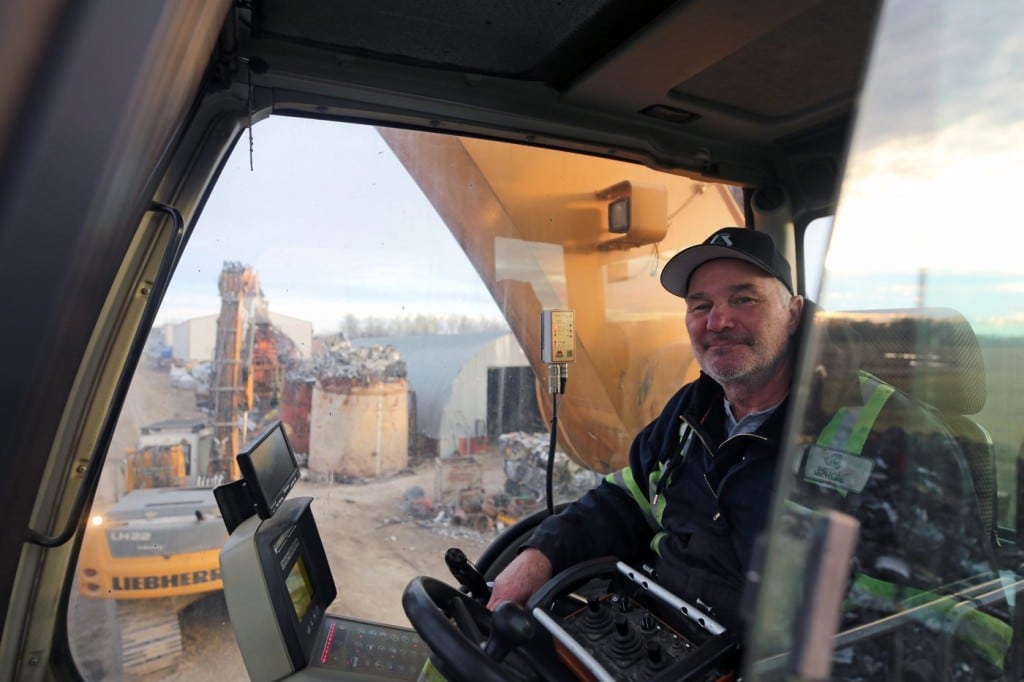
When the Sun visited in late November, heavy equipment operator Ken Hale steered a 3,500-pound claw on an excavator. He used two joysticks to raise, lower, twist, and clench the claw as he dug through a massive pile of metal to process the material for transfer to Selkirk.
Hale was taking unprepared metal, like an eight-foot auger, steel barrels, and steel wall siding from a building, and stuffing the junk into a metal compressor. From the driver’s seat of the excavator, he triggered the compressor with a remote, sheared the metal into prepared form, and then sorted it to get packed into a truck and sent to Selkirk.
“I couldn’t work in an office. I couldn’t do it,” Bale said while the shear sliced metal. “I’ve just been around equipment all my life. I just got a knack for it, I guess.”
Purchasing manager for 2 & 10 Metal Recycling Joe Russell, who just drove a truck load of steel into the scrap yard for sorting, told the Sun that he thinks the nature of metal recycling is misunderstood.
“I just don’t think people understand the importance of it. Of getting scrap metal recycled,” he said. “It’s very misunderstood.”
“Fridges, stove, everything. There’s got to be a place for that to go or it’ll pile up,” Russell said. “The appliances these days don’t last like they used to. It’s a throw away society.”
The environmental impacts of a scrap metal business are often overlooked, he said — the metal recycling business doesn’t get much credit for being environmentally friendly despite its real world impacts, he said.
The rough, jagged, pokey, dirty and dusty exterior doesn’t appear like a green business on the side of the road. But the fact is that the material that the scrap yard recycles would otherwise rust in a field, or in a landfill, he said.
Russell works to find projects in the area, sources for scrap metal, and new customers. Rolling around Westman, there’s plenty of opportunity to find metal laying to waste. He’ll stop in and inquire about the need for cleanup, he said.
“If I’m out on the road and I see a place with a lot of scrap, I’ll usually stop in. But for most part, guys are usually calling us.”
The business has roughly 130 bins that lends to businesses in the Westman area. The businesses fill the bin with their scrap metal, which is then hauled back to the scrap yard and organized for recycling, he said. There’s an ongoing waitlist for pickups at places like autobody shops and landfills, he said, which are constantly needing scrap metal to be taken away.
The morning the Sun visited, a bin had come back from a landfill in the Binscarth area.
The process is environmentally clean because it repurposes junk out of people’s hands, removes waste from landfills, and offsets the demand for new mineral extraction, Flikweert said.
The business has grown in the last 15 years that Flikweert has taken up the reins. He told the Sun that his father passed away, leaving the business to his mother, and he stepped up to carry on the family business for another generation. He has increased the staff roll up to 10 employees from about four, and has invested in a lot of tools since starting.
“We’ve definitely grown since I’ve taken over,” he said. “Upgraded pretty much every piece of equipment.”
Flikweert said that he has a few jobs. He keeps an eye on sales prices of certain materials, and organizes to ship as much as possible during high times; he goes out to sites to assess possible jobs for salvaging scrap metal; and he crawls underneath semi trucks to repair the equipment.
The middle-aged man is covered in dust. He wears high-visibility overalls in a shop with cluttered counters and floors. He wipes truck-engine lubricant from his hands.
“It’s not the cleanest environment for sure. Lots of dust. It’s greasy,” he said. “It’s just a tough environment in general.”
This story was originally published in the Brandon Sun. It is republished under a Creative Commons license as part of the Local Journalism Initiative.
Our Prairie stories matter too.
The Flatlander takes a closer look at the stories that unite us, and make us unique, in Saskatchewan and Manitoba.
Will you help us tell our stories?