
Do Prairie people have a herd mentality?
Flatlander readers weigh in on what they love and hate about the Prairies.
Like every year, there are a number of seasonal viruses floating around out there, and this fall I think I’ve caught them all. Every time I felt better, a day or two later, I would catch something else. I have little kids in my family who bring home a lot of germs, but this year seems particularly bad. I even became well acquainted with the symptoms of pneumonia, which was six weeks of awfulness.
Anyhow, several weeks ago, we talked about the Winnipeg aerospace industry having trouble recruiting. And I asked Flatlander readers, “Is it better the prairies fly under the radar? Or would it be better if we had to welcome the masses – tourists and new residents alike – with open arms?”
There is much to see in ‘Saskatoba’
Don writes:
“I’m originally from the SW MB community of Killarney. I’ve lived in Victoria BC and Halifax NS and I currently live in Ottawa. My girlfriend is a born-and-bred city girl from Montreal who has lived in New York and LA. She was out in the prairies a year ago with me and while she loved certain aspects of the region there just seemed to be too much sky and space for her to handle.
“In my opinion, there are a lot of stereotypes about Saskatoba (that’s what I call the region I come from) “it’s flat!” You can drive for hours without turning the wheel” and “it’s flat,” and that’s about it. But once these people get off the Trans Canada Highway, there is so much more to see. I once met a couple on the hike up Turtle Mountain who were from Mississauga, and they had no idea what kind of country was out here. And if these people are willing to get away from the crowds (have you been to Lake Louise in the summer?) then Grasslands National Park, Riding Mountain, Turtle Mountain, Spruce Woods, Saskatchewan Sand Hills, Cypress Hills, the list goes on and on. It just takes a little imagination to get off the beaten track.
“But, by all means, Golden Horseshoe folks, stay in the madness that is the GTA and bitch endlessly about the commute and the price of housing. The eastern Prairies will always be there to help you realize your dreams of a sustainable lifestyle.”
Local, independent, in-depth.
Our Prairie stories.
The prairie herd mentality?
Alan writes:
“The herd mentality on the prairies is rather depressing. There is more to life than cheap housing.”
Another reader Brian commented that there is more to life than a mortgage. And some people in Canada have found themselves in life-long mortgages as one in five mortgages have negative amortization.
Because interest rates have been going up, people with variable mortgages have seen the principal amount on their loans increase, and as such their loan repayment does not cover the interest costs, which means the banks have been extending their 25-year mortgages to 35 or 40 years.
Evidence suggests the crowd can influence what we think
Regarding herd mentality, the dictionary definition of the term is the tendency of the people in a group to think and behave in ways that conform with others in the group rather than as individuals.
Social psychologists have been kicking this idea around since the 1800s. (See Gabriel Tarde’s 1890 book The Laws of Imitation or Gustave Le Bon’s 1986 work The Crowd: The Study of the Popular Mind).
LeBon wrote, “An individual immersed for some length of time in a crowd soon finds himself – either in consequence of magnetic influence given out by the crowd or from some other cause of which we are ignorant – in a special state, which much resembles the state of fascination in which the hypnotized individual finds himself in the hands of the hypnotizer.”
So basically if we are part of the crowd long enough, it can strongly influence how we think and act for ourselves.
The allusion of popularity can make something popular
There are studies to show if an idea is initially seen as popular it will become more popular.
Academics from Hebrew University, NYU, and MIT did a study where they wanted to look into the idea of “digitized, aggregated opinions.”
For five months, they took online comments, gave them an initial thumbs up or down, and observed what happened. There was also a control group of comments that didn’t get an initial like or a dislike.
If the comment already had one “like,” the next person who saw the comment was more likely to also give it the thumbs up or, in Reddit speak, an upvote, by 32 per cent.
Comments that got artificially boosted with a like saw a 25 per cent increase in the average scores compared to the comments that were initially unliked, and the control group that was neither liked nor disliked.
So a dislike is as good as no likes at all.
Whereas those tiny nudges in the right direction had a snowball effect with the likes on the liked comments taking off.
It’s like how if one person in the room starts applauding, and the whole crowd follows that lead.
So, the next time you see a comment or a post with lots of upvotes, remember, it might’ve just caught a lucky break.
Is something popular because it is good or because it’s popular?
The researchers aren’t exactly sure.
Another study showed opinions aren’t always tied to their popularity. A researcher gave people a list of songs ranked by their popularity. The people were then asked to rank the songs in the order of their preference as well.
Another group was given the same song list, but it was flipped. They were told the unpopular songs were the popular ones and vice versa.
Did this switcharoo mess with their heads?
Yes and no.
The good songs on the flipped list couldn’t quite reach the same level of popularity as they did with the folks who had the correct list. And, the not-so-great songs managed to do better than they would’ve in a fair world.
Researchers also noted certain songs managed to be put back in their popular place on the list. So to some extent, people do have a built-in BS detector, and they could tell some songs were better or worse than the list made it out to be.
Groupthink and keeping the peace
There is also the idea of groupthink, a psychological phenomenon that occurs within a group when the desire for harmony or conformity causes people to agree at all costs without any critical evaluation of the group’s consensus.
A simple example of that would be if you’re parents have a certain political affiliation, you will likely share that affiliation, possibly without much reflection as to why you share their views.
Agreeing to disagree
At the same time, people’s politics are on a spectrum. And if you are on the left part of the spectrum and living in Saskatchewan, the Saskatchewan Party likely long ago wore out its welcome with you, and you’re ready for the pendulum to swing the other way. And it will, eventually when the right set of circumstances presents itself.
If you’re right of centre in Manitoba, then you were likely disappointed that the pendulum recently took a swing to the left.
And that’s fair enough. We all have to live through governments we don’t like for years, sometimes for more than a decade because that’s democracy.
That said, the opposition parties in Manitoba and Saskatchewan have big numbers, just not enough to carry the government at the moment.
Every provincial election in Manitoba and Saskatchewan has thousands of people voting for the NDP and thousands voting conservative. Regardless of your riding, you should be able to find your people, or your own herd, so to speak.
In Saskatchewan’s last election, while the NDP didn’t win, with the exception of six ridings, the party had at least 1,000 people, if not more, turn out to vote NDP.
In Manitoba’s last election, while the conservatives didn’t win, every riding had more than 1,000 people vote conservative, with the exception of five ridings.
If you are in the political minority in your riding and support a smaller third party, it is still worth voting to let your elected MLA know that they will be representing people from a variety of viewpoints, who aren’t necessarily on their “team.”
The big “herd” of non-voters
A lot of people don’t vote.
In the 2020 Saskatchewan election, 47.14 per cent of the eligible voting population didn’t vote. In Manitoba’s recent election, 44.7 per cent of eligible voters didn’t bother to turn up at the polls.
Statistics Canada looked into why people didn’t vote federally, and one can assume a lot of the same reasons apply provincially.
Among eligible Canadians who did not vote in the 2021 federal election, the most common reason for not casting a ballot was not being interested in politics. Other reasons included disability, illness, and being too busy.
As a journalist that bothers me because the question of how to get people to care about local issues keeps me up at night.
Getting more people to vote has bothered politicians too. In 2016, the federal government considered three reforms: electoral system reform, online voting, and compulsory voting to improve voting numbers.
Reforming the system proved to be too tough because they couldn’t agree on an alternative.
At the provincial level, several provinces have tried and failed to change how their provincial elections work. British Columbia, Ontario, New Brunswick, and Prince Edward Island made the attempt without success.
Research showed that compulsory voting would improve turnouts, and it has worked for Australia since 1924.
And online voting would help with accessibility, but security concerns are what have been holding it back.
The rural-urban divide
Another thought to ponder when it comes to herd mentality is that rural areas in Saskatchewan and Manitoba are more politically conservative than urban areas.
This isn’t unique to the Prairies or in Canada. It seems to hold true in the U.S. and Europe.
There is a study out of Western University and the University of Calgary that suggests that since the 1960s, conservative support has become more rural, and the urban areas have become more liberal.
I will use the small “l” liberal here to mean more progressive because the Western provinces have largely rejected the Liberals at the provincial level.
One theory about the Liberals not being popular out west is because they are the party of Ontario and Quebec and the Prairies have always historically felt alienated from central Canada since elections are generally decided by these two provinces.
Going back to the 1950s and 1960s, Conservative Prime Minister John Diefenbaker identified as a small-town Prairie lawyer and criticized business and media elites in Canada’s big cities, which in turn may have pushed urban voters away from conservatism.
And when you look at party policies, like gun control. Most city folks don’t need a gun. They don’t have farm animals to protect. (Although some city people do have guns for hunting or just shooting at the range, so I don’t want to overgeneralize).
The Liberals’ promise of $10-a-day child care is more appealing to people living in the cities where the cost of child care is more of a concern than the availability of the service.
But that said, there are a lot of issues that unite people across parties—access to health care, affordability, and jobs to name a few. And when you get into the weeds of each political party, there are policy disagreements within each, going back to politics being on a spectrum.
The long and the short of it is people care about a lot of the same problems, but we’re not necessarily going to agree on the exact solutions.
Consensus governments
An interesting idea to me is how Nunavut and the Northwest Territories run their territorial governments. They don’t use the party system. (The Yukon does. It currently has a Liberal premier).
Nunavut and Northwest Territories have a consensus government, meaning MLAs are elected as independent candidates.
If Alan’s comment is saying people might be weary of living in Saskatchewan because of a conservative government, well there aren’t many places to go in Canada that don’t have some type of conservative government.
Newfoundland and Yukon currently have Liberal premiers and B.C. and Manitoba have NDP leadership.
And if you think the Prairies don’t have enough representation in Ottawa, each territory only gets one Member of Parliament in the House of Commons, for a total of three, so trying to focus the national conversation on northern issues is likely very difficult.
Change from within
Meanwhile, Saskatchewan has no Liberal Members of Parliament, which is what voters decided, but it means the province has no one in the party who can speak up for Saskatchewan’s interests within the governing party.
Half of New Brunswick’s 10 MPs are Liberals, and eight out of 11 MPs in Nova Scotia are Liberals. Six out of seven MPS in Newfoundland and Labrador are Liberals. And PEI is four for four. That is 27 MPs that can push from within the ruling party for their provincial interests, like exempting home heating from the carbon tax. And according to both the NDP and Conservatives, the Liberals made the carbon tax decision to try to safeguard those Liberal seats in the future.
Zack Taylor of Western University, who was one of the authors in the study I mentioned above on the rural/urban political divide told the CBC that he is concerned that “when parties become uncompetitive in each other’s turf for very long periods of time … they can’t recruit good candidates, they can’t be visible to voters. And as a result, they don’t really hear what people in those regions want and what their hopes and aspirations and fears are.”
Politics is a tricky business.
Rod wrote:
“I would like to see more people come to the prairies. Move out from the east and come west. It would only be better for us to have a larger population. (My opinion).”
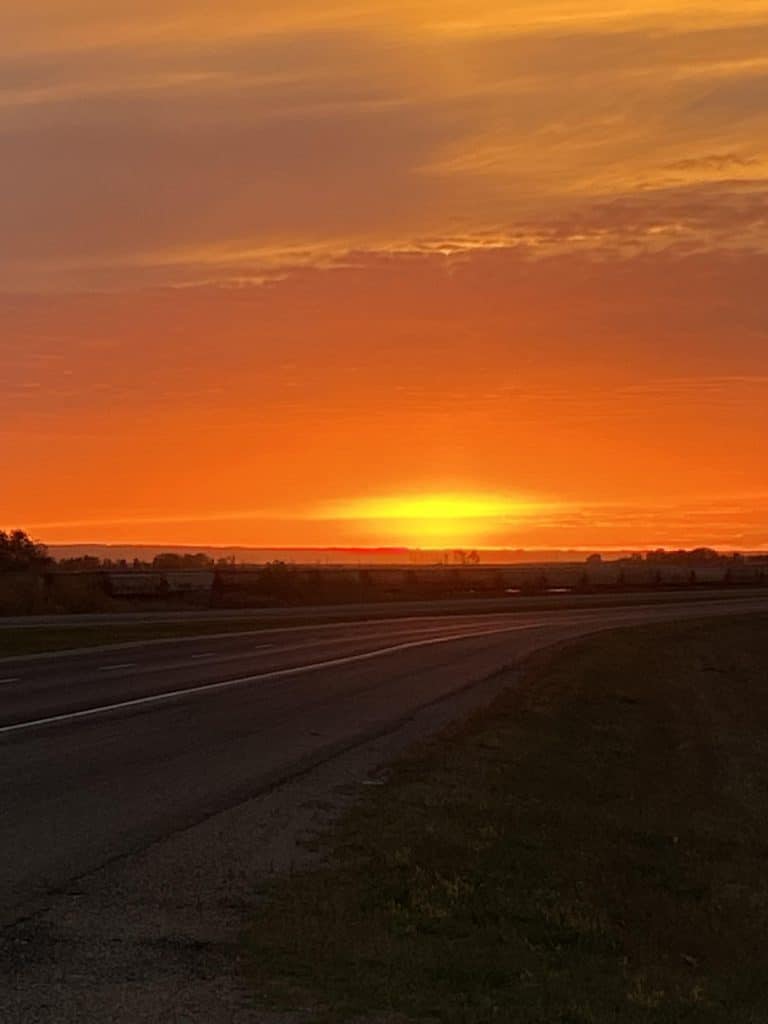
He also sent a picture of the sunset from Highway 16, west of North Battleford.
Myra brought up six points about why Saskatchewan, in particular, might be undesirable for people living outside the province:
“1. The Education System
“I don’t know about MB, but the education system in SK is being controlled by a right-wing government who got their pronoun ideology from an Evangelical right-wing group. This right-wing group is small but vocal. QAnon is making inroads into the rural areas of the province (see Kamsack). If you aren’t researching and writing about this, you are missing out on a lot of what is going on in the prairie regions. “
It is true that the national Christian organization Action4Canada takes credit for influencing the Saskatchewan Party’s decision to adopt pronoun and sexual education policies that affect school children.
Political commentators see the pronoun bill as the Sask Party throwing a bone to those that are farther down the right side of the political spectrum as they are fearful some voters might turn against them in favour of the Saskatchewan United Party. (And by using the not-withstanding clause they wouldn’t let the courts stand in their way).
As for Romana Didulo, a QAnon-inspired conspiracy theorist, and more than 15 of her followers, who have been travelling around Canada over the last few years, they did not receive a warm welcome when they arrived in Kamsack, and they later drew the ire of residents around Richmound, who wanted them gone. The group recently left the village and is camped out on unused land in the Rural Municipality of Fox Valley.
Didulo’s group, which has threatened to execute government officials, has been defined as a cult and the RCMP is keeping watch.
Didulo has 36,000 Telegram followers, which isn’t nothing, and there is the possibility of violence, but her popularity is limited.
That aside, everyone should be concerned with misinformation and disinformation and its impact on society.
Here is a guide from Simon Fraser University on protecting yourself from misinformation.
The Canadian Centre for Cyber Security also offers this guide.
“2. Transportation
“Air Canada and WestJet have a sweetheart collusion deal going on in Saskatchewan.
“West Jet flies only west out of SK while Air Canada flies only East out of SK. Consequently, it has become extremely difficult and expensive to fly east or west out of the province. I have family members on both coasts, and it is very demoralizing when I cannot easily visit one another due to the connecting flight factor and extra expense. There may be some great work going on at the universities here, but very few that allow our children to stay and work in the province. “
The problems with air travel are on The Flatlander’s radar, see Flying Winnipeg to Saskatoon requires a stopover in Toronto.
Some good news for Reginans is that West Jet recently announced a direct flight from the Queen City to Minneapolis, which is helpful if one wants to connect to more options for air travel within the U.S.
“3. Recreation and Tourism
“It’s true that SK has vast areas of boreal forest dotted by 100,000+ lakes, but northern tourism promotion is not being funded adequately. And then there is the transportation problem to get people there as well. The roads are not well developed or maintained. Most people in southern SK have not been further North than Saskatoon.“
I used to travel and work extensively in Northern Saskatchewan. And yes, there are some very bad unpaved roads, and if you hit them on a rainy day, you can be sliding and bouncing all over the roads. On dry days, some dirt roads are so dusty that visibility becomes a problem as vehicles kick up thick clouds, and being blind to oncoming traffic doesn’t always stop people from passing.
I haven’t been along Lake Hansen Road recently, which is a major Northern highway in Saskatchewan, but as far as I know, it still doesn’t have cell phone coverage, which always gave me a little anxiety when driving it because any vehicle trouble could have you sitting on the side of the highway for a long while.
Going north is indeed an adventure.
“4. The Economy
“It’s not doing as well in SK as some might think. We have a current unemployment rate that has risen to just over 5.4%. According to the Realtors Association, Full-time job losses in August occurred in agriculture, utilities, construction, trade services, accommodation & food services, and public administration.
“Job losses in agriculture, hotels, restaurants and construction? This points to bad economic signs ahead. “
The unemployment rate is a bit of a moving target. The most recent unemployment numbers for Saskatchewan at the end of October was at 4.4 per cent, according to Statistics Canada. This is the lowest among the provinces.
The province saw a 9,100-person jump in employment in October, meaning there were 605,300 people employed, according to the data.
The unemployment rate in Manitoba was 5.2 per cent in October 2023.
“5. Access to Shopping
“It is very difficult to find upscale women”s and men’s clothing here. Example: Several women’s wear shops have moved out of Saskatchewan. people have to go to Calgary or Winnipeg to shop. “
Up until a year ago, I lived five hours north of Saskatoon in the Pierceland area, so shopping online was one option, as parcels could generally be picked up at the post office or a nearby local business that was a third-party hub for certain couriers.
When it comes to having success with buying clothes online, you have to take your measurements and compare them with your brand’s size guide and be comfortable with the return policies and procedures.
Even many high-end fashion, like Prada for instance, will ship, but they aren’t going to leave a $3,000 purse on your doorstep. They require a signature upon receipt.
Some luxury brands that don’t have locations in Canada, like Tom Ford, don’t ship outside Canada, but you can buy some of their items through a third-party retailer like Harry Rosen.
Of course, if you want to try on clothes without the hassle of maybe having to return them, then you will have to travel if what you want is outside your geographic area or isn’t able to be delivered to a P.O. Box (if you live in a rural or remote area).
Sometimes I waited until I was in the city to shop. Lloydminster, which was two hours away from where I lived, offered some shopping variety if I was looking for craft supplies, Indian food, and some clothing retailers.
Edmonton is closer than Saskatoon to Pierceland. It was a three-and-a-half-hour drive which offered much more shopping than LLoyd, so some people took weekend Costco trips there from Northern Saskatchewan.
If you weren’t making the trip yourself, you might ask a friend to pick up a few items from Costco.
I remember being in Sandy Bay, Sask., in the Northeast, and people there would ask friends to bring back certain fast food items they missed, even though it would be at least a day old by the time it got there. They would reheat the food in the microwave.
“6. Supply and demand problem? People in SK likely cannot afford it and the stats support this assumption: From Dashboard: In June 2023, Saskatchewan’s average weekly earnings (seasonally adjusted) were $1,168.96, the eighth-ranked among provinces in terms of value. Nationally, the average was $1,203.64. Saskatchewan’s average weekly earnings increased by only 2.6% from June 2022 to June 2023. Nationally, earnings increased by 3.6%.“
This is also a moving target as the numbers from August now show Saskatchewan fifth and Manitoba eighth. The latest numbers are below.
| Alberta | 1,291.94 |
| Ontario | 1,247.55 |
| British Columbia | 1,229.63 |
| Newfoundland and Labrador | 1,212.77 |
| Saskatchewan | 1,168.37 |
| Quebec | 1,166.99 |
| New Brunswick | 1,119.76 |
| Manitoba | 1,108.73 |
| Canada | 1,217.88 |
Five stories from Manitoba you may have missed
- New honour for Selkirk’s Dufferin Gang shouldn’t be its last, says committee
- New ‘living lab’ to research greenhouse gas emissions
- Evictions being used to battle drug trafficking on Pine Creek First Nation
- Winnipeg woman sues Tim Hortons alleging cream in tea led to hospitalization
- Education bureaucracy has learning to do: advocates
Five stories from Saskatchewan you may have missed
- Clinical trial in Sask. to help ovarian cancer patients make more informed decisions
- Prince Albert inmates on hunger strike for long-term concerns, including poor water quality
- Police investigating after Creative Saskatchewan defrauded of more than $331,000
- First Nations and Mennonite women of Manitoba reveal sustainability lessons
- Man facing charges after ambulance stolen in Saskatoon, police say
Our Prairie stories matter too.
The Flatlander takes a closer look at the stories that unite us, and make us unique, in Saskatchewan and Manitoba.
Will you help us tell our stories?
Author

Related Articles
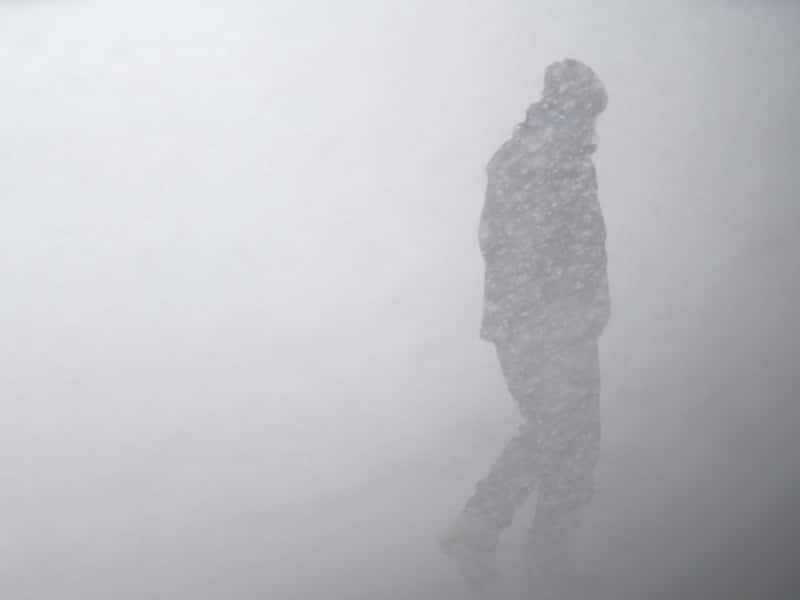
Saskatchewan screamer? Manitoba mauler? Prairie storm names explained
After last week’s defence of sunny Prairie winters, a fast-moving Alberta clipper arrives to remind Saskatchewan and Manitoba who’s really in charge—bringing sudden cold, sharp winds, and one of winter’s strangest nicknames. Depending on where it crosses the border, the same storm takes on far more dramatic names.
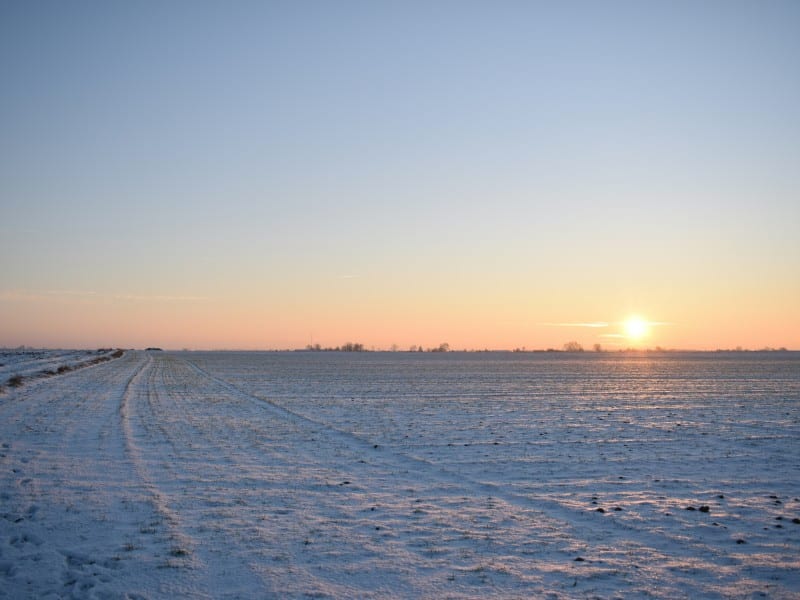
B.C. gets more rain. The Prairies have more sunshine.
Vancouver gets about 1,938 hours of sunshine a year. Winnipeg gets roughly 2,353. Regina clocks in at 2,338 hours, Saskatoon at 2,268. One of the sunniest cities in Canada is Estevan with 2,404 hours.
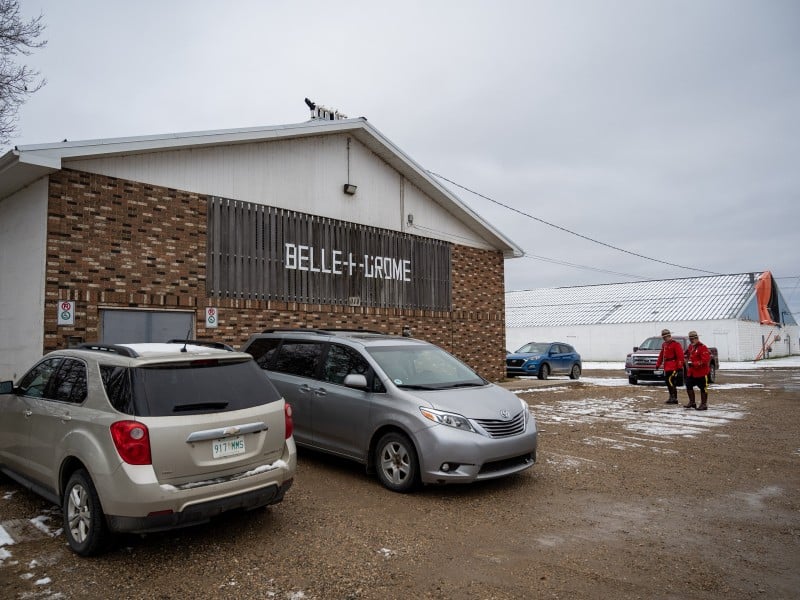
If you were mayor of Duck Lake, Sask…
Whatever happens next in Duck Lake, it’s clear that Prairie residents care deeply about their history, identity, and sense of place.