How Winnipeg’s hysterically boring buildings inspired movie Universal Language
Rankin credits his interest in cinema and his career as a filmmaker to the Winnipeg Film Group. Run by Dave Barber, who died in 2021, the Winnipeg Film Group was “the bridge between this very isolated city and world cinema,” says Rankin.
Since premiering at the Cannes Film Festival in May 2024, Universal Language’s blend of surreal comedy and aching pathos has garnered a devout audience.
Written by Ila Firouzabadi, Pirouz Nemati, and Matthew Rankin, who also directs, Universal Language blends several seemingly unrelated stories to create a bizarre yet relatable tale of hope.
“We wanted to make a movie about togetherness, but on a really radical level,” Rankin tells The Flatlander over Zoom. “This movie isn’t about conflict or confrontation. It’s a gentle movie because humans can share, collaborate, create, and protect each other. That’s why we’re all still alive.”
Rankin returned to his home city of Winnipeg to shoot Universal Language, his second feature film after 2019’s The Twentieth Century. Born and raised in the city, Rankin moved to Montreal when he was 18, where the 44-year-old has spent most of his life.
Local, independent, in-depth.
Our Prairie stories.
Rankin credits his interest in cinema and his career as a filmmaker to the Winnipeg Film Group. Run by Dave Barber, who died in 2021, the Winnipeg Film Group was “the bridge between this very isolated city and world cinema,” says Rankin. A keen drawer from a young age, Rankin started taking animation workshops there, while this is also where he first picked up a camera and learned how to film.
“I was really inspired by the filmmakers in Winnipeg,” continues Rankin. “Richard Condie and Guy Maddin. There was Norman McLaren, too, but he was based in Montreal. It probably wouldn’t have occurred to me to become a filmmaker if I hadn’t observed people in my own community doing it.”
Rankin first had the idea for Universal Language, thanks to Winnipeg, too. Growing up, his grandmother regularly told Rankin a story about how she and her brother found a $2 bill frozen in the ice on a Winnipeg street during the Depression. “It just captured my imagination,” says Rankin.

Years later, as he immersed himself in Iranian cinema, Rankin saw parallels between his grandmother’s story and the Iranian films he was watching. “They’re usually about children facing adult dilemmas and them navigating this confusing world. My grandmother’s story reminded me of the plots of some of these movies.”
Rankin was touched by the idea of these two seemingly different worlds having a connection. He then worked with his friends Firouzabadi and Nemati, who were born in Iran but are now based in Montreal, to expand the idea. “We’ve been talking about this movie for 12 years. It really emerged out of long conversations between us.”
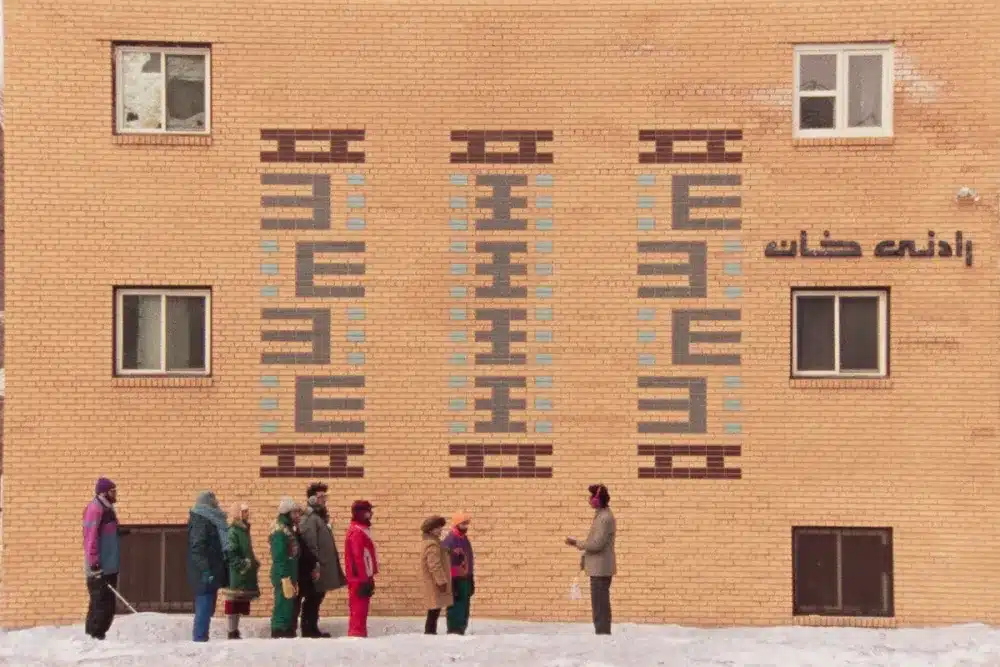
Filming on Universal Language took place in Montreal and Winnipeg, with Rankin insisting that he wanted to shoot the architecture of his home city in a particular manner. “There’s something about the boring Winnipeg buildings that is beautiful. I love how the structures reflect light in the winter.” Rankin believes these Winnipeg buildings act as a perfect metaphor for Universal Language. “I find them really beautiful. But still boring in a comical way. That absurdist design is also the space of the movie.”
Ultimately, though, while Rankin, Firouzabadi and Nemati didn’t create Universal Language with a political message in mind, he believes that its depiction of “gentleness and kindness” feels radical in the current climate. “I have an idealism about what cinema can achieve. We can’t convey gentleness and kindness in politics, economics or social media. But with art, you can show it and make an impact.”
Our Prairie stories matter too.
The Flatlander takes a closer look at the stories that unite us, and make us unique, in Saskatchewan and Manitoba.
Will you help us tell our stories?
Author