
Minnedosa’s antique clocktower fixed
A trained clock restorer flew from Mexico as part of an effort to restore the clock tower on Minnedosa Town Hall.
An antique clock worker has restarted the hands of time above Main Street Minnedosa with a little help from the local government.
Les Shuttleworth, a trained clock restorer, flew from Mexico as part of an effort to restore the clock tower on Minnedosa Town Hall. Shuttleworth landed in Winnipeg and road-tripped to Minnedosa, spending three days repairing the clock and teaching locals to continue in his absence.
On the third storey of Minnedosa Town Hall, a century-old Victorian clock has provided beauty and time since the First World War. The clock froze seven years ago and remained broken, until this summer.
It was Shuttleworth’s sister who got him involved in repairing the Minnedosa clock. She was travelling through the Westman town when she sent him a message about the broken clock; she knew he’d taken a two-year post-graduate course in antique clock restoration at the University of Sussex, and thought he might want to help.
He did.
Local, independent, in-depth.
Our Prairie stories.
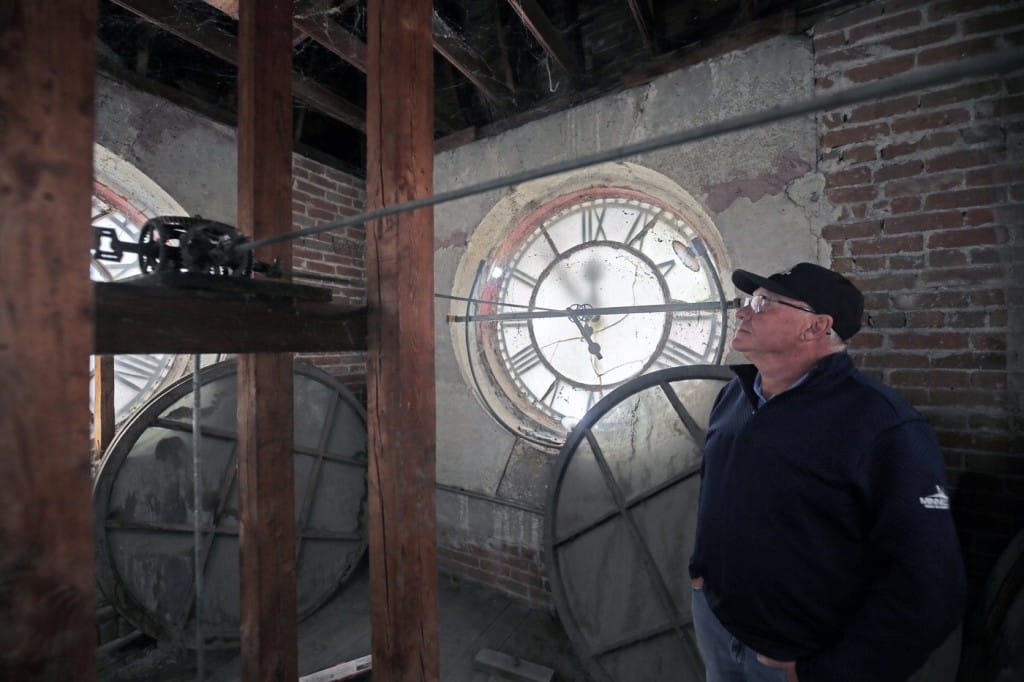
Striking up a deal with the local town not long later, Shuttleworth then flew to Manitoba to visit the clock tower. The Town of Minnedosa paid for his hotel and gas during the stay, however his flight came out of pocket, he said.
“I combined a family visit with my sister and checking out the clock on the same trip,” Shuttleworth said.
He said fondness of the area contributed to his decision to help out. He said his family has history in the area that dates back more than 100 years.
“I love old clocks, and it’s pretty exceptional that Minnedosa has one of the very, very few functioning town clocks in Canada,” he said. “Minnedosa is a wonderful town and my long family connection there made me want to help out in any way I could.”
After travelling to diagnose the issue, what Shuttleworth found was that the system of intertwined mechanical gears had stopped for a simple reason. It took a few hours to sort out, he said.
“Nothing was broken or worn, just misaligned,” he said. “Over time, more than a hundred years I’d say, the screws had loosened due to vibrations of the clock ticking.”
The issue was simple, but “There was just no one who knew enough” to solve the problem, said Minnedosa CAO Danniele Carriere.
Shuttleworth is one of a rare bunch that are able to confront a nest of gears, pendulums and swinging arms and identify where the problem lies. It’s a niche skill set that doesn’t get much use in Canada, so he’s happy to have found a use near family, he said.
After fixing the issue, Shuttleworth spent three days cleaning the clock parts and preparing them to survive as long as possible, he said. They will likely outlast most human beings alive today, keeping that history and culture continuing for the next generation, he said.
Now that he has returned to Mexico, the responsibility for the clock falls on local government. A councillor has volunteered to take the helm for now.
Grant Butler, a councillor at the Town of Minnedosa, tagged along for the restoration project to learn. He said Shuttleworth trained him to maintain the clock going forward, and he will pass along what he learned.
The culture and the history are important to keep alive, he said, that’s why he made an effort to get it going again.
“I think it’s unique to the community. And I think it’s something we can utilize,” Butler said. “It’s an attraction and it’s part of the history of the town. And it’s a shame to see this type of technology go away and not be utilized.”
It takes a bit of elbow grease to run the clock, because it is mechanical and depends upon gravity. The primary task is to lift 270 pounds, said Butler.
Every seven days, the 270-pound weight must be raised to the ceiling as a way to power the whole system. Suspended by a cord, the weight perpetually inches toward the floor, pulling the cord, and that powers the system, he said.
He is planning to get a staff member to take up clock management after the dust has settled from the revival. Butler said he will pass along his knowledge when the time comes, and he still has one thing to learn.
“I learned a lot about clocks in three days,” he said from the tower, in front of mechanical gears. “Most of that was cleaning, but a lot was trying to get the bell system working.”
Although the clock has been repaired, the same is not true of everything in the clock tower. A pin is broken in the bell system, so the town bell no longer rings with the passing hours.
To fix the bell, Butler plans to reach out to volunteers in Ontario. Volunteers in Almonte are managing a similar heritage clock and bell, and he believes the answer will be found with some elbow grease and consultation.
The town plans to change the bell so it rings only on occasions, such as Christmas, Butler said.
The town is also looking to add an arm to one face of the clock tower, which is currently missing one.
Shuttleworth thinks Minnedosa is a great example to other towns that history is important, and conservation and restoration of architecture brings life to the area. He highlighted that the town’s role has been critical as people asked for council to restore it, and council put in a strong effort to get the job done.
The clock is more than a century old, but Shuttleworth said things still look solid under the hood. It has many more years left to tick, he said.
“Because of the original quality, the clock is still in near perfect condition. It should easily run for another 100 years,” Shuttleworth said.“The clock was built with exceptional quality. English clocks of that time were very well designed with high quality materials.”
The clock was manufactured in England. It was built as part of the Minnedosa Civic Centre, which was erected between 1913 and 1914.
This story was originally published in the Brandon Sun. It is republished under a Creative Commons license as part of the Local Journalism Initiative.
Our Prairie stories matter too.
The Flatlander takes a closer look at the stories that unite us, and make us unique, in Saskatchewan and Manitoba.
Will you help us tell our stories?
Related Articles


Stroke survivor embraces Christmas tradition
Neil Friesen, a 76-year-old local of Wawanesa, has a seven-foot-tall tree in his living room this year, decorated with ornaments. The returning Christmas tradition comes as Friesen looks at the world with new eyes.

Nipawin firefighters save Christmas gifts in late-night house fire
The call marked Nipawin Fire’s 249th response of the year, the highest number on record to date.