Parents worried students being left behind, teachers’ union wants more classroom supports
Without adequate funding, Saskatchewan Teachers Federation has warned of an overstressed education system that is already cracking under significant student population growth, a lack of educational professionals, and significant changes to education funding.
Saskatchewan parents are frustrated by the lack of support available to their children at their schools.
One Humboldt parent, Lindsay Gabriel, said the shortage of education resources has put her daughter, who uses a wheelchair, at risk of injury.
There are no specialized desks and equipment for her child.
This means Gabriel’s daughter has had multiple falls while transferring in and out of her wheelchair, one of which resulted in a concussion.
Her daughter hasn’t had an appointment with a school occupational therapist in over a year. Such a staff member could help Gabriel’s daughter work through this problem. And even when she has seen the therapist in the past, the appointments are short, only lasting 10 minutes.
Local, independent, in-depth.
Our Prairie stories.
This ongoing problem compelled Gabriel to speak at a rally in Humboldt in October, where 200 people gathered outside Finance Minister Donna Harpauer’s office.

Besides improving her daughter’s learning environment and safety, Gabriel said accessibility within the entire school is also an issue.
At her daughter’s school, students with disabilities have no access to the stage to participate with classmates during concerts, and there are only two wheelchair-accessible doors in and out of her school out of a possible five. Gabriel worries what will happen if there ever is a need to evacuate quickly.
Another one of Gabriel’s children needs a speech-language pathologist, and last school year, her child was only seen twice.
“There is no opportunity for meaningful practice of speech with two visits in 10 months and no EA (educational assistant) support in the school to assist the practice either,” she said at the Humboldt rally. “Some families can work with private providers to support their children, but this is simply not an option for all families. And why should these students be left behind?”
Gabriel said teachers have always been strong advocates for her children, and speaking up at the Humboldt rally was a small way she could support them in return.
She said if parents want things to improve for teachers and their kids, they must start doing the same.
Another parent, Kisanne Geis, said she has had to advocate for her autistic son Hamilton since he started Pre-K in Assiniboia.
Now, in Grade 1, he never knows which EA he will be working with on any given day or knows where he’ll be working.
The lack of educational professionals has also been an ongoing concern for Geis because the lack of child psychologists and occupational therapists within the school division means she must pull Hamilton from school and take time off work to attend private appointments.
Geis was one of 500 people who went to a rally in Moose Jaw outside Minister of Education Jeremy Cockrill’s office in October.
The Saskatchewan Teachers’ Federation (STF), the union that represents 13,500 Saskatchewan teachers, has spent the last nine months trying to negotiate an increased education budget to deal with growing class sizes and to hire more specialized staff to help children like Gabriel’s and Geis’ with intensive needs, as the number of students with special requirements has grown by more than 38 per cent over a 10-year-period.
The government and the STF were back negotiating this week. It had been four months since the two sides had been at the bargaining table. However, the talks did not last long. On Tuesday, the two sides were at an impasse.
Negotiations for the newest collective bargaining agreement started last May before the 2019-2023 agreement ended in August.
“We came to the process in good faith and with a set of opening proposals, but always ready and always with the authority to have a back and forth, to get to a point where both sides can be satisfied, or at least equally unhappy in the process,” said Saskatchewan Teachers’ Federation president Samantha Becotte in an interview on Feb. 1.
Budget tensions
Tensions rose between STF and the provincial government after the 2023-2024 budget was released.
The government announced Saskatchewan’s 27 school divisions would receive $2.04 billion in school operating funding, a 2.5 per cent increase from last year, but still falling short of what the STF said is needed.
With inflation and projected student enrollment up, Becotte said a five per cent increase was required to maintain last year’s operating levels.
Therefore, Becotte said the 2.5 per cent increase will not maintain the status quo, let alone improve student support.
Jaimie Smith-Windsor, president of the Saskatchewan School Boards Association, agrees.
“This budget contributes to the existing instability and continuing erosion of the publicly funded education system. School boards are increasingly concerned about that,” he said in a March 22 press release.
Last April, the Saskatoon Public School Division emailed parents and caregivers warning of increased class sizes and fewer resources for students who require more support.
The government had earmarked $256 million for the school division for the year.
But SPSD warned parents that this was insufficient to fund enough support staff for students with intensive needs. Such staff include educational assistants, special education classroom teachers, speech-language pathologists, school counsellors, nutrition workers and English as an additional language staff. Funding for these employees has been significantly underfunded since 2021.
The school division also said the exclusion of capital projects from the budget would lead to challenges due to the overcrowding in several schools in the northeast part of Saskatoon.
SPSD asked parents and caregivers to contact their MLA.
In response, the Saskatchewan government announced $40 million to provincial school boards in June.
Half the money would go towards addressing student enrollment increases, while the remaining amount was for additional support staff, like educational assistants, speech-language pathologists, counsellors, and psychologists.
The STF said the additional funding still wasn’t enough, referring to 2022 data from the Fraser Institute that said Saskatchewan needed $400 million to restore per-student funding to 2012-13 levels.
“There is still chronic underfunding pressures throughout the division,” said Saskatoon Public School Board Chair Colleen MacPherson in a June 21 press release announcing her area’s budget.
Without adequate funding, STF has warned of an overstressed education system that is already cracking under significant student population growth, a lack of educational professionals, and significant changes to education funding.
According to Statistics Canada, Saskatchewan received the most per-student funding in the 2012-2013 school year, with $15,233 per student in school board operational funding. By 2020-2021, that amount had dropped by 10 per cent, and Saskatchewan had fallen to eighth place above Alberta and New Brunswick.
The 2022-2023 school year saw the largest growth of Saskatchewan’s school populations in the last 20 years, according to the province’s Ministry of Education, something the Saskatchewan government has been quite proud of; however, the STF said school support has not grown with it, according to STF.
According to the Saskatchewan Education Sector Staffing Profile, since 2016, the number of full-time teachers has only increased by 0.1 per cent, while the number of students has increased by 8.8 per cent.
If one looks at the 2016 numbers compared to today, Saskatchewan has just 10 more full-time regular classroom teachers than the province did back then, but 15,000 more students.
Over the last year, Saskatchewan schools lost about eight per cent of their specialty staff, including counsellors, psychologists and speech-language pathologists.
The number of specialists who are also certified teachers decreased from 112 in 2022 to 95 in 2023.
Last year, there was only one speech-language pathologist per 1,413 students, one psychologist per 2,904 students, and one social worker per 2,588, numbers that have the STF concerned.
Becotte said these numbers validate what teachers, students and parents say about today’s classroom problems.
“The Sask. Party Government caused this problem by cutting per-student funding,” she said.
Both parties at the table
Both parties have spoken about coming to the table in good faith but have failed to reach any compromise.
Becotte said the STF would settle for a deal where both parties are equally unhappy since that signifies a good deal.
Over the summer, the government ran a billboard campaign to highlight that their initial offer to Saskatchewan teachers would have them earning more than the Western Canadian average.
However, Becotte said the $92,000 salary advertised on the billboards is misleading. A new teacher makes $60,000 and would require eight years of experience and, in some cases, a master’s degree to achieve that salary.
Last year, 65 per cent of teachers made $92,000 or more.
Based on all teachers’ earnings, the average salary is $88,619.70.
Saskatchewan’s offer was a seven per cent salary increase over three years. Still, Becotte said the government’s focus on salary is meant to distract from the large class sizes and not enough staff.
In a video posted on Premier Scott Moe’s social media last Thursday, Education Minister Jeremy Cockrill said provincial negotiators have a new negotiation mandate to allow an extension of the current salary offer or use the same salary formula that MLAs receive.
“Those salary adjustments would be based on the cost of living,” said Cockrill.
Rallying for education
A public rally held at the Saskatchewan Legislature in Regina on April 29 following the provincial budget drew 3,500 students, teachers, and concerned members of the public from across the province.
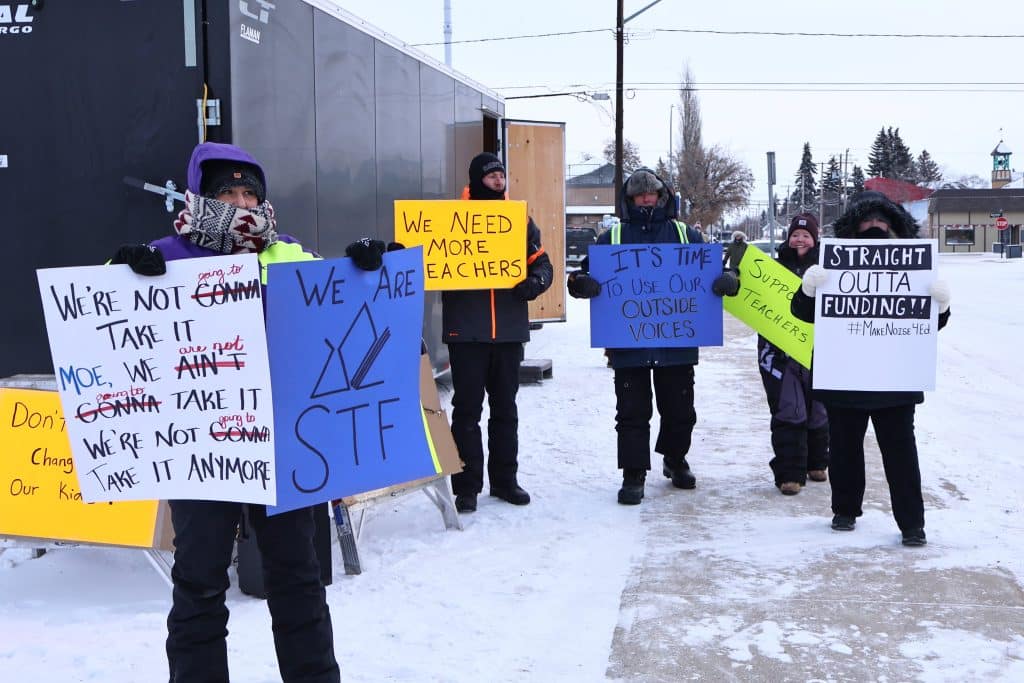
Even more rallies were held in October as bargaining negotiations ground to a halt. Over 7,700 people attended events in Saskatoon, Humboldt, Moose Jaw, and North Battleford, all of which were held in front of MLA offices on four consecutive Saturdays.
Another 13,600 emails and over 500 phone calls were made to government officials, according to the STF.
At the beginning of this process, Becotte hoped the number of days of job actions would be zero, but eventually it couldn’t be avoided.
One-day walkout
After the STF polled its members, the union found that 95 per cent of teachers agreed to sanctions and the government was given five days of notice to return to the table before schools were shut down for a one-day walk-out on Jan. 16.
Even with the bitterly cold temperatures, -37 with the wind chill and wind gusts reaching upwards of 48 km/hr in Humboldt, hundreds of teachers from across the region gathered to march in and around the centre of the city, said Verna Lyn Gorrill, Horizon School Division’s Teachers Association president.
Across Saskatchewan, it is estimated that 13,000 teachers participated in job action, the first strike since one that lasted three days in 2011.
Minister Harpeaur did not attend the October rally, and a sign on her door on Jan. 16 did not indicate why her Humboldt office was closed that day. A sign stated they would be open the following day.
Becotte said this was the case in a few communities where parents reported constituency offices were closed for the day without explanation.
When asked for a comment about the rallies in October, Harpauer wrote via email that she respects everyone’s right to protest and reach out to her about current issues.
“I appreciate that individuals are engaged in the political process. I share a common interest in education and its importance to our province. Educators and support staff continue to contribute and play a vital role in our education system, and I will continue to recognize that fact,” she said.
What’s happening now?
On Friday, STF members will withdraw noon-hour supervision provincewide, and there will also be another one-day rotating strike that day.
“This government is trying to sidestep the bargaining process,” Becotte said in a video posted to social media Tuesday. “(The government does) not want to make long-term commitments that they can be held accountable to, to ensure that our students get the support that they need.”
On Wednesday, the Saskatchewan government announced the Teacher Innovation and Support Fund recipients, awarding $410,000 to nine teacher-led initiatives at eight schools.
The province introduced the $2.5 million grant in January.
Teachers can work with their school administration to apply for up to $75,000 to pursue local projects that improve student achievement, student and teacher wellness, and school safety to work.
Additionally, the government announced $32 million for 45 portables that will provide new classroom space, mainly in Regina and Saskatoon, to address increasing class sizes due to population growth. Humboldt, Lloydminster, Lumsden, Pilot Butte, Warman and Weyburn will also receive some funds for this.
Portables are attached to schools when the building has reached its capacity and needs more space for additional classrooms.
The new funding for the portables is in addition to the $16 million in the 2023-24 education budget that was allotted for 23 new portables and two relocations, contributing to a total expenditure of $48 million for the year.
“The Ministry of Education stated that this investment further enhances previous efforts to tackle classroom complexity, referring to the $40 million announced in June.
Becotte said these recently announced funds are an effort by the Saskatchewan government to avoid bargaining at the table in good faith on classroom complexity.
She said commitments made outside of contract talks don’t go far enough to ensure stability in the education sector for years to come.
“[If] it’s not in the collective bargaining process, there is no dispute resolution if the government were not to hold up their side of the agreement, so essentially it’s an agreement with no accountability,” Becotte said at a virtual media conference on Wednesday.
Beck said at a media briefing that the onus is on Saskatchewan Party to return to the table.
-with files from Kelly-Anne Riess
Our Prairie stories matter too.
The Flatlander takes a closer look at the stories that unite us, and make us unique, in Saskatchewan and Manitoba.
Will you help us tell our stories?
Author