Report reveals significant pay differences between Winnipeg, rural school support staff
A new report from the Canadian Centre for Policy Alternatives released Friday exposes the disparities among school division salary grids across the province.
The majority of school support staff in rural Manitoba earn far less than their colleagues in Winnipeg, even when their wages are adjusted for cost-of-living differences.
A new report from the Canadian Centre for Policy Alternatives released Friday exposes the disparities among school division salary grids across the province.
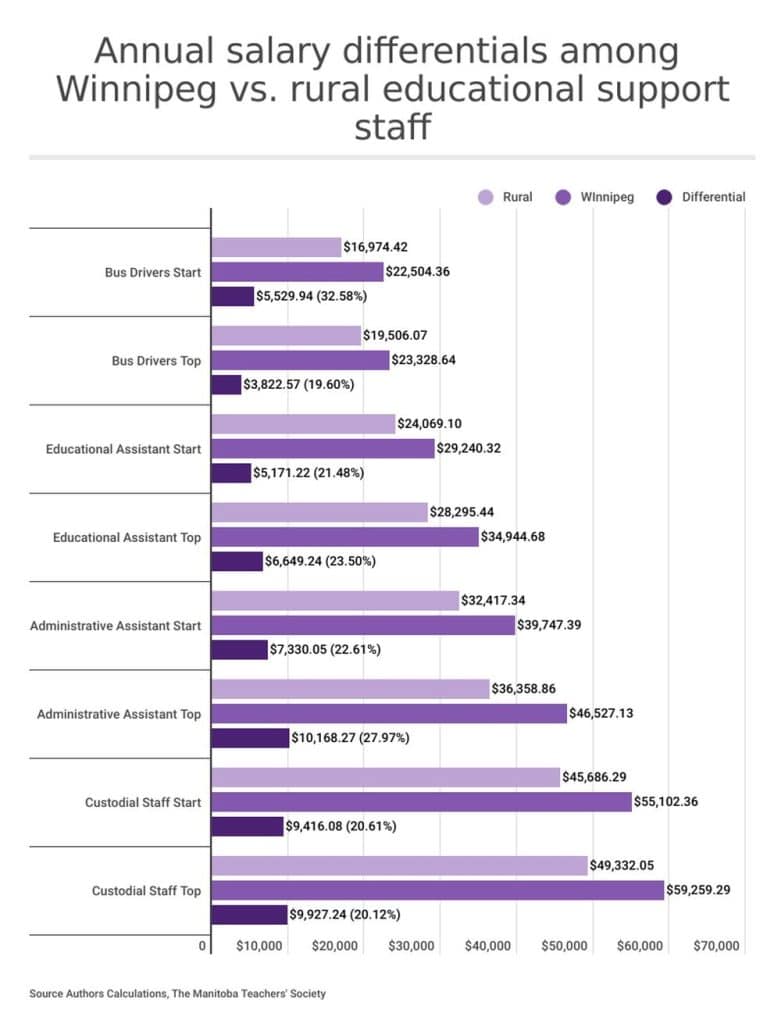
The progressive think tank, whose mandate is to investigate social, economic and environmental justice issues, focused on the earnings of educational assistants, bus drivers, custodians and administrative assistants.
Adjustments ranging from 20 to 33 per cent are required to make up pay differences between rural divisions and those in Winnipeg, according to a CCPA analysis of collective agreements.
Local, independent, in-depth.
Our Prairie stories.
The research team’s calculations also indicate Winnipeg workers make at least 12 per cent more than their counterparts in Brandon in most job categories, yet the difference between a family of four’s annual expenses in the two cities is less than eight per cent.
“We wanted to understand what was behind (a recent) increase in labour unrest,” said Niall Harney, a senior researcher at the centre who authored the 24-page report called Falling Behind: What Explains a Wave of Strikes in Rural Manitoba School Divisions.
Over the last two years, there have been three noteworthy bargaining stalemates — in communities in and around Minnedosa, Lorette and Steinbach — between rural boards and unions representing kindergarten-to-Grade 12 education workers.
Custodians and cleaners in the Rolling River School Division walked a picket line for 92 days during the 2021-22 school year.
A strike was narrowly averted in the Seine River School Division in the spring, owing to an 11th-hour deal reached the weekend before workers were slated to take job action.
More recently, about 300 EAs employed by the Hanover School Division were away from work for three weeks in protest of low wages amid a cost-of-living crisis.
Harney and his colleagues sorted boards into four regions — Winnipeg, Brandon, rural and northern/remote — and noted sizable discrepancies between averages in the Manitoba capital and divisions situated in farming communities.
Rural education support employees are paid $4.01 to $6.48 per hour less than their counterparts, and those gaps grow when pay is annualized and as workers gain experience.
“The question of whether or not support staff are paid fairly outside of the city of Winnipeg has been brewing for a long time,” said Geoff Dueck Thiessen of the Christian Labour Association of Canada, whose membership includes EAs in Steinbach-area public schools.
Hanover residents have long been “resigned” to the fact EAs, increasingly “highly skilled” positions that require tasks ranging from catheterizing to performing sign language, are unpaid, Dueck Thiessen said.
The union’s Winnipeg regional director noted the rural community generally opposes school board fee hikes and property owner savings were historically cited as an excuse.
A shift happened in early 2021, when the Tory government froze all board of trustees’ abilities to raise funds for programming locally through property tax increases, he added.
The province’s late-2022 decision to postpone a new K-12 funding formula — a project to improve equity, including but not limited to addressing discrepancies between rural and urban boards — also set the backdrop for the CLAC Local 306 strike.
For Harney, Manitoba’s support staff pay gaps are a pressing issue because they impact the quality of education.
“We’re in a labour shortage across multiple industries right now, and we need to ensure that our schools can compete for workers and that, ultimately, they can deliver students the high-quality education that they deserve.”
The Manitoba Teachers’ Society is currently undertaking its first round of provincial bargaining with the government.
“Considering the uniformity of pay for teachers across Manitoba, there is an issue of fairness for education support staff…. While workers may, with varying degrees of success, attempt to win justice for themselves through strikes and other concerted effort, the reality is that systemic problems generally require systemic solutions,” the new CCPA report states.
Harney and Dueck Thiessen are both in favour of systemic intervention to equalize the playing field for support staff. (Notably, these workers are not represented by a single union, unlike their teacher colleagues.)
Education Minister Nello Altomare’s office declined to comment on the matter until the CCPA report was made public and can be reviewed by provincial officials.
This story was originally published in The Free Press. It is republished under a Creative Commons license as part of the Local Journalism Initiative.
Our Prairie stories matter too.
The Flatlander takes a closer look at the stories that unite us, and make us unique, in Saskatchewan and Manitoba.
Will you help us tell our stories?
Author