University of Saskatchewan blasts off with rockets and satellites
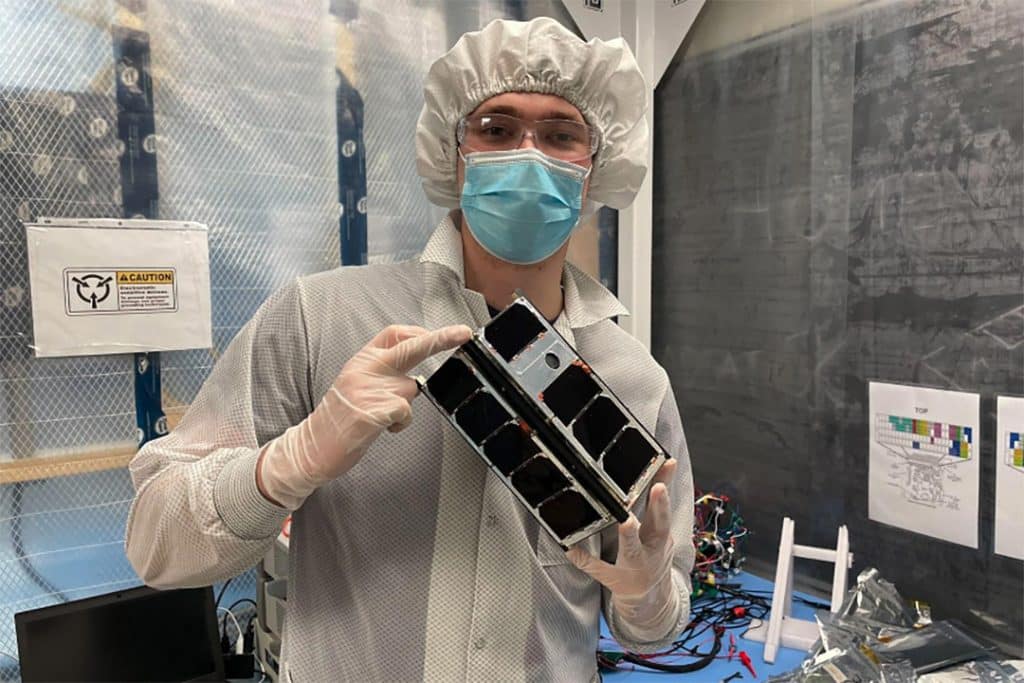
Hundreds of students who have passed through the school in the last few years helped build the University of Saskatchewan’s (USask) first CubeSat, dubbed “RADSAT-SK.”
In Saskatoon, the University of Saskatchewan Space Team (USST) is a student group dedicated to working on space projects.
Hundreds of students who have passed through the school in the last few years helped build the University of Saskatchewan’s (USask) first CubeSat, dubbed “RADSAT-SK.”
“The main motivation for our mission is radiation-based experiments,” said Layne Ransom, a mechanical engineering student at USask.
Onboard RADSAT is an experimental dosimeter board, which is a device that measures radiation. This experimental one is less costly than current commercially available dosimeter boards. Researchers want to see if this new one can hold up in orbit.
Parts of RADSAT are also coated in fungal melanin to see if it can act as a radiation shield.
Local, independent, in-depth.
Our Prairie stories.
Melanin, a substance that produces pigments, helps fungi inhabit the most extreme habitats on earth.
RADSAT was launched into space in June and ejected into space from the International Space Station in July at the same time as the University of Manitoba’s (UM) Iris CubeSat. The two universities worked closely together after both received money from the Canadian Space Agency’s (CSA) Canadian CubeSat Project.
Ransom said it’s exciting to know the students’ hard work led to RADSAT being in orbit.
“Honestly, it doesn’t even feel real,” she said. “This project has been one of the most incredible opportunities that I’ve ever had. To think that something that myself and my fellow team members have worked on is now actually in space, that is a pretty incredible feeling.”
Both UM and USask also received additional funding from the CSA’s CubeSats Initiative in Canada for STEM (CUBICS) program to build a second CubeSat to be launched into orbit in the future.
For their second CubeSat, which is currently in development, USask has partnered with the University of Regina, which is developing a payload for the CUBICS-funded CubeSat.
Blasting off
Another group of students within the USST focuses on the rockets that get satellites into space.
The USST rocketry division is designing and building a rocket for the 2024 Launch Canada Challenge.
Launch Canada is an organization that aims to advance the aerospace field and, each year invites universities to participate in a competition to build rockets.
The USST rocketry team is building a rocket to compete in the Basic category, said USask student Rosy Hettiarachchi, project manager, systems co-lead and a member of the propulsion subteam.
So far, the group has built and launched a 26-inch-tall prototype rocket from a nearby farm to test out materials and systems design, Hettiarachchi said.
“It has been a huge learning process,” she said. “We are still looking into what types of models we can use and what type of materials would be more feasible for dealing with the vibrations. The mini rocket was a success, but we found out there were some calculations that we missed, and we saw how the material could fail.”
The competition rocket will be around 10 feet tall and must reach a minimum launch height of 10,000 feet.
Since she wants to work in aerospace, Hettiarachchi said, it’s beneficial to have projects like the Launch Canada Challenge to work on where she can use her skills as a mechanical engineer.
Hettiarachchi, an international student from Sri Lanka, said the USST was one of the reasons she decided to attend USask, along with good online ratings for its mechanical engineering program and its affordability.
She wants to specialize in rockets in the future and would love to work for SpaceX.
Other space-based research at USask
CubeSats aren’t the only type of satellite work at USask.
The school is also involved with satellites that conduct atmospheric research.
Dr. Adam Bourassa, a professor and faculty member in Physics and Engineering Physics, is part of the Institute of Space and Atmospheric Studies (ISAS), founded by seven professors in the department.
“We use radars and satellites to study the atmosphere and the near-earth space environment, so basically where the edge of the earth’s atmosphere is influenced by physics of space,” Bourassa said during a recent interview from his office at the university.
ISAS has 15 to 20 graduate students and research associates working within the institute at any given time, building and testing prototypes for radars and sensors and analyzing the data from them once they are operational.
HAWC
USask is a primary participant in the upcoming High-altitude Aerosols, Water vapour and Clouds (HAWC) mission, part of NASA’s Atmosphere Observing System.
According to the CSA, HAWC will “provide critical data to support extreme weather prediction, climate modelling, and monitoring of disasters, such as volcanic eruptions, wildfires and extreme precipitation. HAWC consists of three innovative Canadian instruments and a Canadian satellite.”
The mission will launch in 2031 and be in orbit for at least five years.
“Two of those three Canadian sensors were developed in our lab here at the University of Saskatchewan,” Bourassa said.
The sensors have been in development for a decade. USask students involved in the development process build prototypes and test them on airplanes and stratospheric balloons, massive balloons carrying payloads into the stratosphere.
OSIRIS
Although developed in the 1990s and launched in 2001, Bourassa said USask’s Optical Spectrograph and Infrared Imaging System (OSIRIS) continues to be a big project for the school.
OSIRIS is currently taking measurements of the ozone layer aboard the Swedish Odin satellite.
“OSIRIS was made to look sideways through the atmosphere, so it scans up and down and looks at the different layers of the atmosphere as it flies around its orbit, and that was something that was very new at the time,” Bourassa said.
OSIRIS launched on Odin around the time when the world was concerned about the depletion of the ozone layer due primarily to chlorofluorocarbons (CFCs).
In its 22 years orbiting Earth, it has provided and continues to provide researchers with valuable information about the continuing recovery of the ozone.
The data OSIRIS has collected is in major international climate reports submitted to the United Nations.
SuperDARN
The Super Dual Auroral Radar Network (SuperDARN) project uses radars on Earth that look up at the edge of space.
SuperDARN is a network of over 30 high-frequency radars in the Northern and Southern Hemispheres.
SuperDARN Canada is headquartered at USask and headed by Dr. Kathryn McWilliams.
Bourassa said SuperDARN studies space weather, which is high-energy interactions caused by solar wind.
While humans can see visible sunlight and feel its heat, high-energy particles come with the sunlight, Bourassa explained. Humans can sometimes see these high-energy particles interact with our atmosphere in the form of auroras (the northern lights in Canada). Still, aside from that, we generally can’t observe them without instrumentation.
These high-energy particles are incredibly variable, and solar flares and sunspots influence them. They can cause electrical problems with power lines or pipelines that feel these significant electrical effects at the upper edge of the atmosphere.
The SuperDARN radars monitor and understand the solar wind’s interaction with the atmosphere’s edge.
While McWilliams was unavailable for an interview, she said in an email that SuperDARN will receive new funding in November.
Bourassa said USask is allowing students to find new paths into an aerospace industry that has grown since rocket company SpaceX made going into space less expensive.
“There is a lot more interest across a lot more industries with things that can be done from orbit, and I think we’re seeing a lot more startup companies, spinoff companies that are doing things from space that have never been done before,” Bourassa said. “We’re training students in these areas at the university, and we’re providing these students with skills in aerospace, remote sensing, and space physics that could be really important for industry in the future. And there is also potential for spinoff companies to come out of this university research. It’s happened before, and it could happen again.”
One such company was SED Systems, which USask scientists and researchers formed in 1965. Calian Advanced Technologies in Ottawa later acquired it.
The company provides infrastructure for satellite ground systems.
While there is excitement about satellites on the prairies, the near-constant launch of satellites over the last few years has also caused some issues for astronomical researchers, which we will look at during our final instalment of this series on the space industry that will feature work at the University of Regina.
Our Prairie stories matter too.
The Flatlander takes a closer look at the stories that unite us, and make us unique, in Saskatchewan and Manitoba.
Will you help us tell our stories?
Author