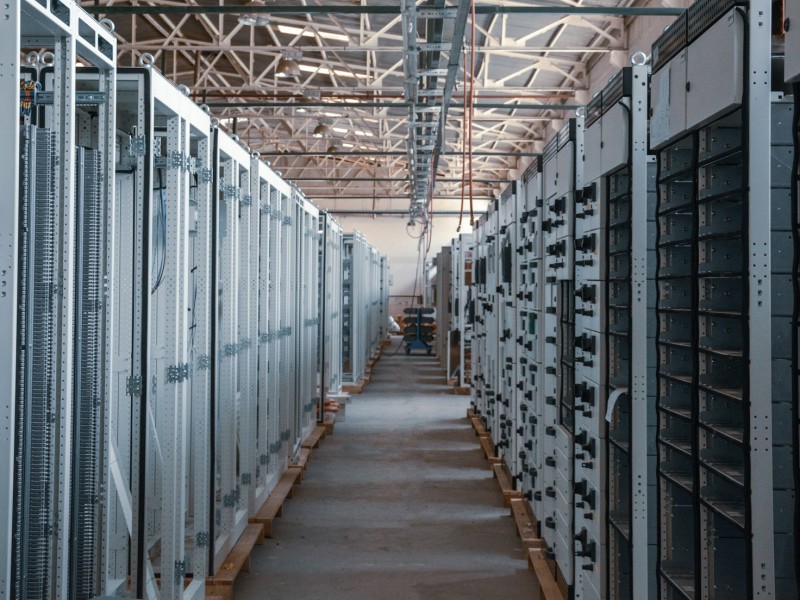
Can Manitoba power its AI ambitions?
The Manitoba government is positioning the province as a future hub for artificial intelligence and data infrastructure, part of a broader shift toward what is being called the “fourth industrial revolution.”
The goal is to attract investment built around data, computing power, and digital services.
But while data centres promise jobs and economic growth, they also raise questions about electricity, water and infrastructure.
High-risk economic ambition
Premier Wab Kinew framed the push towards data infrastructure as a chance for Manitoba to move beyond its “have-not” status and build the economy by focusing on AI and intellectual property.
Local, independent, in-depth.
Our Prairie stories.
The timeline to get there is short because the province is trying to balance its books, moving from a deficit of $1.6 billion to a projected balanced budget by 2028. Analysts have raised concerns about how realistic this path is, especially given relatively modest economic growth forecasts.
With a planned surplus of $8 million for 2027-28, which is a thin margin representing less than 0.1% of annual revenue, there is no room for error. In a climate of trade disruptions and tariffs, this leaves the province’s fiscal health vulnerable to even minor economic headwinds.
The hydro question: everything depends on power
Any data centre built in the province would be relying on Manitoba Hydro to power it.
However, the Crown utility previously warned that generating capacity could be strained without new sources of electricity.
To keep up, Manitoba Hydro is moving ahead with a series of major projects: purchasing 600 megawatts of power from new, majority Indigenous-owned wind farms, planning three new natural gas turbines in Brandon, upgrading existing hydroelectric stations, and testing battery storage.
None of this comes cheap. Replacing and modernizing Manitoba Hydro’s aging transmission system alone carries an estimated $7-billion price tag.
And all this is happening while the utility is recovering financially. Last year, Manitoba Hydro posted a $502-million loss, largely due to drought. The province is now forecasting a rebound to a $140-million profit, but that turnaround depends on something no government controls: precipitation.
If water levels don’t recover, both Hydro revenues and available electricity could fall short.
Meanwhile, demand is rising. Manitoba Hydro warned it could face winter power shortages within four years. It lacks the capacity to connect new energy-intensive projects to the grid. New generation will be needed by 2029 just to maintain reliability, before factoring in additional demand from something like a data centre.
So could a data centre strain the system?
When the Winnipeg Free Press asked a Manitoba Hydro spokesperson that question, the answer was “possibly.”
Data centres require massive amounts of electricity. But housing, industry, and everyday life depend on that same power.
Commit too much capacity to large industrial users, and the province risks losing adaptability down the road.
This is what experts describe as a “lock-in” effect, which happens when a long-term decision, like committing huge amounts of electricity to a data centre, limits what you can do in the future.
Because these facilities require constant power for decades, that energy is spoken for, even if priorities change. In practice, it means less flexibility to redirect electricity to things like housing, transportation, or other industries later on.
Two very different data centre projects in Manitoba
Currently, two separate data centre projects are drawing attention in Manitoba.
1. The Bell AI Fabric project
Bell Canada is already building a data centre just outside Winnipeg’s northwest edge, in the CentrePort industrial area in the Rural Municipality of Rosser.
Unlike many large-scale data centres, this one isn’t being built from scratch. Instead, the company is retrofitting a shuttered food-processing facility, the former Merit Functional Foods plant, into a smaller computing site. The project involves modifying the existing structure to be able to support generators, chillers, and transformers. Building permits indicate at least $31.5 million in construction.
Bell has framed the project as part of its “AI Fabric” initiative, an effort to build “sovereign AI” infrastructure in Canada, where data and computing capacity are controlled domestically rather than relying on foreign providers.
In terms of energy use, this is a relatively modest facility. It will require about 5.5 megawatts of electricity, a tiny fraction of Manitoba’s overall generating capacity.
The Midwestern Project
A second proposal, often referred to as the Midwestern Project, is far larger, and more controversial.
The project is being explored by Convergence Compute, a joint venture involving U.S.-based Jet.AI and Vancouver-based Consensus Core Technologies. The proposed site is roughly 350 acres of agricultural land just north of Île-des-Chênes, in the Rural Municipality of Ritchot.
Unlike the Bell facility, this would be a much larger data centre campus built to support computing demands tied to artificial intelligence.
This data centre will require 500 megawatts, which would be comparable to powering the City of Calgary.
The project is expected to use onsite natural gas generation and a closed-loop cooling system to manage server heat. The system uses highly purified water that only needs replacing about once every 10 years, with the water trucked in rather than drawn from local sources.
Unlike the Bell project, this proposal is still in its early stages. The local council has not yet received a formal application or rezoning request.
Despite that, the data centre is already generating strong opposition. A petition has gathered more than 4,000 signatures from residents concerned about potential impacts, including:
- constant low-frequency noise from turbines
- light pollution
- declining property values
- and pressure on local infrastructure and the power grid
Our Prairie stories matter too.
The Flatlander takes a closer look at the stories that unite us, and make us unique, in Saskatchewan and Manitoba.
Will you help us tell our stories?
Author