Discovery Centre re-discovering Triceratops fossil Frankie
Frankie was set aside while its famous reptilian cousin Scotty the T.Rex was being cleaned and prepared for display.
The T. Rex Discovery Centre in Eastend Saskatchewan has been busy re-discovering a long-stored fossil. This summer, staff, including Mollie Black, lead hand at the centre, have been busy working on the fossil of a Triceratops.
The dinosaur, nicknamed Frankie after its original discoverer, Frank McDougall, in 1994, was first found in a similar area to the famed Scotty the T.Rex. However, unlike its more famous reptilian cousin, Frankie was set aside while the T.Rex was being cleaned and prepared for display.
This Triceratops, meaning “three- horned face,” is believed to have died and remained on the surface for a while, with other creatures from that era, including beetles, gnawing on its left-behind bones.
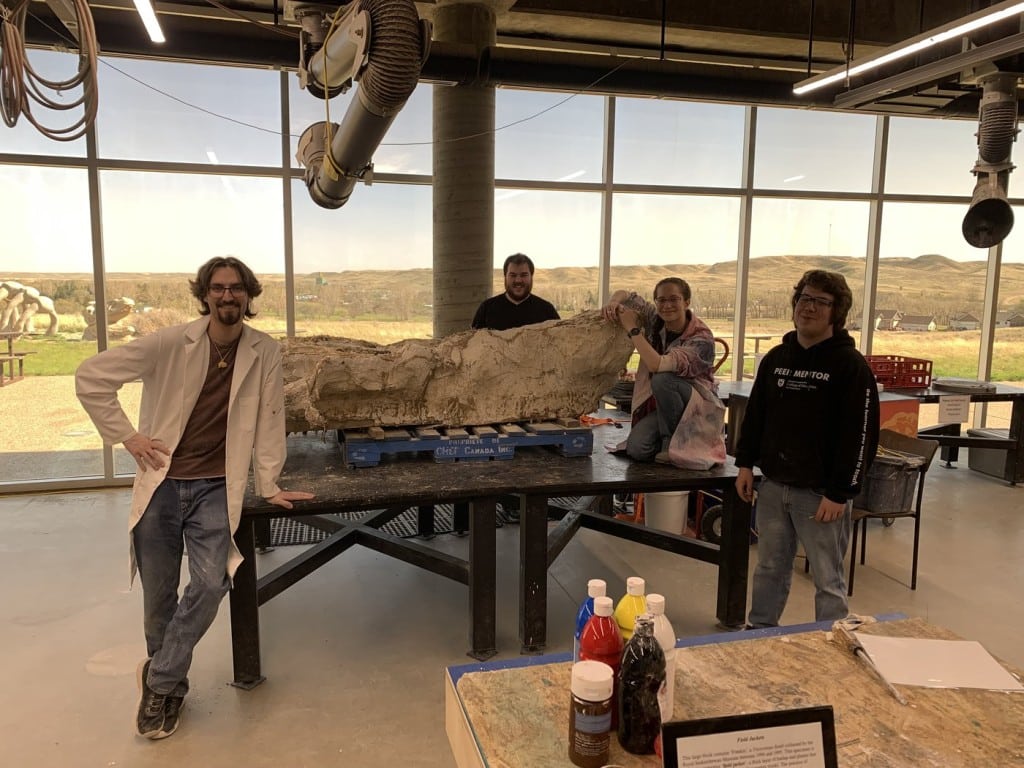
According to Mollie, Frankie is not a complete fossil but a partial one, with workers having to piece it together “chunk by chunk and glue it back together.”
Local, independent, in-depth.
Our Prairie stories.
While the original Scotty, whose “birthday” is listed as August 16, is kept in the collection at the Royal Saskatchewan Museum, Frankie’s birthday was just passed on May 30.
When asked if the partial bones would ever be sold, Mollie Black mentioned that, unlike in the USA, Canada has strict fossil protection laws to prevent the sale of fossils. Fossils are protected under the Saskatchewan Heritage Act and are property of the Crown.
It took approximately 15 years to complete Scotty, but it wasn’t until 2025 that work began on reassembling Frankie. The expectation is that the Triceratops will be available for display next summer (2026).
For more information on this discovery and to learn about Frankie and its more famous relative, Scotty, contact the T. Rex Discovery Centre at 1-306-295-4009 or email trex.centre@gov.sk.ca.
This story was originally published in The Shaunavon Standard. It is republished under a Creative Commons license as part of the Local Journalism Initiative.
Our Prairie stories matter too.
The Flatlander takes a closer look at the stories that unite us, and make us unique, in Saskatchewan and Manitoba.
Will you help us tell our stories?