Climate change will worsen our already bad roads
By mid-century it is expected that the Prairies will see an increase in the frequency of freeze-thaw cycles causing a more rapid deterioration of road infrastructure.
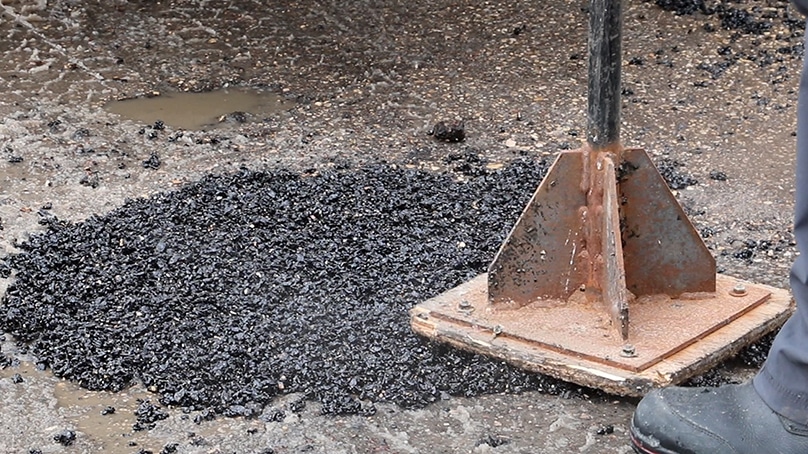
Potholes scar our Prairie roads. In any given year, there are more potholes than a municipality can fill.
What causes potholes?
Potholes are caused by the freeze-thaw cycle we often see in spring weather. During the day, the sun shines, and the snow melts, causing moisture to seep through the cracks in the roads. As night comes, the temperature drops below freezing, and the water that’s made its way below the pavement expands and turns to ice, creating potholes.
According to a report by the Prairie Adaptation Research Collaborative, the Prairies are expected to see an increase in the frequency of freeze-thaw cycles by mid-century, which will cause the rapid deterioration of road infrastructure.
Local, independent, in-depth.
Our Prairie stories.
Drought conditions can cause soil beneath the roads to dry up, causing roads to crack.
Hot temperatures heat up the road surface and cause rutting. Pavement swells under the sun and buckles if it expands beyond limits.
If the temperature rises above 35°C for an extended period, the asphalt in Saskatchewan is at risk of softening. This happened to runways in the United Kingdom in 2022 during a heatwave when the temperature soared to 37°C.
You might think construction crews in Death Valley, California, use asphalt, and the summer highs there can exceed 45°C, so why would it soften in Britain or Saskatchewan? This comes down to the asphalt binder a region uses in its roads, and Death Valley uses one for higher temperatures.
Communities use historical weather data to choose what sort of asphalt binder they use, but with climate change, that historical data is not as helpful in predicting future conditions.
Asphalt binder is made from bitumen, a sticky black byproduct of refining crude oil. This “glue” keeps the gravel and sand together to form the asphalt, which needs to be tough enough to handle heavy traffic and weather.
A 2020 Memorial University of Newfoundland study noted that Regina and Winnipeg would need to upgrade to a higher-temperature asphalt grade. Winnipeg also needs to upgrade its low-temperature asphalt binder grade. Such upgrades come with an extra cost but will be necessary.
Infrastructure failures increasing worldwide
Countries around the world are already facing historic heat waves.
In addition to melting runways in 2022, a busy road in Britain was closed for hours after it buckled under the high temperatures. Police said the heat damage made the road look like a skatepark ramp.
Warming temperatures have also caused recent infrastructure failures in America, Australia, China, and Africa.
Temperatures on the Prairies have surged by about 1.5°C since 1948, the amount of late spring rain has increased, and patterns are expected to intensify under all climate scenarios.
If the world successfully lowers its emissions, warming on the Prairies will continue to increase only slightly from historical trends; however, under a high-emissions scenario, our local temperatures could increase as much as 6°C this century.
These temperature changes mean we could be in for a bumpier ride.
A 2016 Natural Resources Canada report on climate risks and adaptation opportunities for the country’s transportation sector says our changing weather patterns will greatly impact the country’s roads, causing the rutting and softening of asphalt. Like this spring in Regina and Winnipeg, an increase in rain could mean more flooding and erosion. And the more frequent freeze-thaw cycles, the more potholes.
The poor state of Canada’s roads
A 2021 CAA study already found that the average Canadian driver spends an extra $126 on their car per year due to poor road conditions.
The 2019 Canadian infrastructure report card, authored by a group of engineering, construction, transit, and public works associations, found that about 16 percent of the country’s roads—some 146,000 kilometres—are in poor or very poor condition.
“There are enough Canadian roads in poor condition to build a road almost halfway to the moon,” reads the report. “The state of our infrastructure is at risk.”
Especially because about 80 percent of the country’s roads and highways are in the latter half of their lifespan.
Canadian roads are old, and there isn’t enough money to go around to fix them all.
Most roads last about 50 years, but their lifespans can be extended to around 70 years if properly maintained.
According to the most recent 2018 State of the Infrastructure report, Winnipeg has an average of 7,335 km of roads.
On average, most of these roads are about 48 years old, and Winnipeg hopes to extend their life by another 25 years. Sixty percent of these roads were considered in good or very good condition.
Regina’s infrastructure report is more recent, having been published in 2022. About 55 percent of its 4,400 kilometres of roads are in good or very good condition.
Regina has 4,400 km of roads. On average, they are over 40 years old, and the city estimates they can last another 30 years.
As climate change hastens damage to our aging roads, a 2021 report from the Canadian Climate Institute estimates that, due to climate-related damage, Canadian governments will need to spend about 20 percent more per year on road fixes.
That adds up to an extra $3.1 billion annually.
Our Prairie stories matter too.
The Flatlander takes a closer look at the stories that unite us, and make us unique, in Saskatchewan and Manitoba.
Will you help us tell our stories?
Author