Paving the way to the future: tackling road durability challenges on the Prairies
Two prairie scientists are finding ways to build better roads in Saskatchewan and Manitoba.
In Saskatchewan and Manitoba, where temperature extremes test the limits of road engineering, researchers in Winnipeg and Saskatoon are working to create more durable roads.
“If you’re dealing with only high temperatures, like in Florida, it will be easy to design a good road,” Dr. Haithem Soliman, an engineering professor at the University of Saskatchewan, said. “If you are only dealing with cold temperatures, that will also be easy, but finding a good material that will perform well in both extremes will be very expensive.”
The coldest day ever recorded in the Prairie provinces plunged to a bone-chilling -56.7°C in Prince Albert, Saskatchewan. In contrast, the hottest day soared to a blistering 45°C in Yellow Grass, Saskatchewan.
This staggering temperature range of 102 degrees presents a formidable challenge for civil engineers, especially when factoring in the region’s clay-like soil.
Saskatchewan and Manitoba have relatively small populations connected by huge road networks, which also makes budget constraints a significant hurdle.
Local, independent, in-depth.
Our Prairie stories.
“You’re dealing with so many factors,” said Soliman. “It is very interesting and very, very challenging.”
He and his PhD students use the Canadian Light Source synchrotron at the University of Saskatchewan to understand what happens inside asphalt when exposed to heavy traffic loads and extreme temperatures.
The synchrotron advantage
The synchrotron is a machine that accelerates electrons to near-light speeds. These electrons race around a large ring using radio waves and super-strong magnets, releasing energy through very bright and focused light. This light is then used to examine asphalt in extraordinary detail.
The light bounces off the samples, helping Soliman take detailed pictures of inside the asphalt. These pictures show how all the tiny pieces fit together and whether there are any cracks or weak spots.
Before synchrotron analysis, asphalt samples are exposed to freezing and thawing cycles to mimic real-world conditions. This process allows Soliman and his team to observe how different materials react to the extreme temperature fluctuations typical of the Prairies.
The insights gained from these detailed examinations are compiled into a large database to aid designers in adapting their road-building techniques.
The making and breaking of asphalt
A typical asphalt mix comprises two main components: aggregate (a blend of rocks, stones, and gravel) and asphalt binder (the glue that holds the aggregate together). For a road to be strong, the large stones in the aggregate must fit together tightly and be well-coated with the binder.
However, water infiltrating the pavement, followed by freezing and thawing, can cause significant damage. The expansion of the ice cracks the large stones into smaller pieces, weakening the road structure.
Soliman and his students use the synchrotron to identify materials that might better resist this temperature damage.
Optimizing asphalt in Manitoba
Meanwhile, Dr. Ahmed Shalaby and his students are looking at optimizing asphalt mixes at the University of Manitoba.
Shalaby aims to create more durable pavements that last longer and develop fewer cracks, ultimately reducing road lifecycle costs.
His research process tests asphalt samples created in controlled laboratory conditions and those collected from construction sites.
Machines simulate the effects of traffic and environmental conditions on the asphalt.
One such test involves applying loads to a sample for up to 30,000 cycles, mimicking years of traffic wear in a compressed time frame. These tests are conducted at various temperatures, from a frigid -30°C to a sweltering 46°C, to assess performance across different climate conditions.
“This allows us to compare how long this material would last on the road,” said Shalaby.
The performance tests let researchers know what materials and processes produce longer-lasting pavements.
Shalaby’s and Soliman’s research could allow transportation departments across the Prairies to allocate their budgets more efficiently, focusing on critical repairs and improvements rather than constant maintenance.
“Road construction projects are massive in size and volume,” said Shalaby, adding that even small changes to asphalt can mean huge savings for local governments and more durable roads.
Embracing recycled materials
A major focus of current research for both Shalaby and Soliman is increasing the use of recycled materials in road construction.
Recycled materials can include old asphalt, recycled concrete aggregates, shingles, and plastics, which not only reduce costs but also divert waste from landfills.
While recycled content has been used in pavements for decades, it only makes up about 10 to 20 per cent of the asphalt content, said Shalaby.
However, industry interest in using even more recycled materials in road construction has grown recently, so researchers are now pushing to incorporate 50 to 60 per cent of recycled materials in mix designs.
This will allow municipalities to source locally, which is cheaper than importing aggregate from afar.
This means asphalt mixes can be tailored to the resources that are locally available and for specific climatic conditions. For example, the asphalt mix used in Regina could differ from that used on a highway in northern Saskatchewan.
Soliman said this shift towards higher recycled content reduces costs, conserves natural resources, and minimizes waste.
But, using recycled materials also presents the challenges of ensuring consistent performance, as the materials could be of varying ages and come from a number of differing sources, said Shalaby.
“We’re trying to make road construction more environmentally friendly while maintaining or improving durability,” said Soliman.
Hot-in-Place Recycling: a modern approach to road repair
One new technology emerging to enhance road durability is called Hot-in-Place Recycling (HIR).
It’s a method that reuses the existing asphalt on the road.
Special machines heat the old asphalt, making it soft enough to be scraped and mixed with a rejuvenating agent, effectively restoring it to like-new condition.
This recycled mix is then spread out, smoothed down, and compacted to create a solid and smooth surface.
There are three different ways to do this recycling.
One is surface recycling. Only the top layer of asphalt is reused, and no new material is added, so the road stays the same thickness.
A second way is to mix the old asphalt with new material to make a stronger surface. This can include adding extra asphalt or rocks.
Another way is to recycle the old asphalt and add a new layer on top, making the road thicker and more durable.
Cutting road construction’s carbon footprint
Soliman’s and Shalaby’s research also focuses on reducing the carbon footprint of the entire road construction process.
Using recycled materials and HIR can help reach this goal by reducing the use of heavy machinery and long-distance transportation of materials.
Another new process involves cold water mixing asphalt, which cuts energy use and emissions during road laying. Normally, asphalt requires heating to temperatures between 130°C and 150°C during mixing and application.
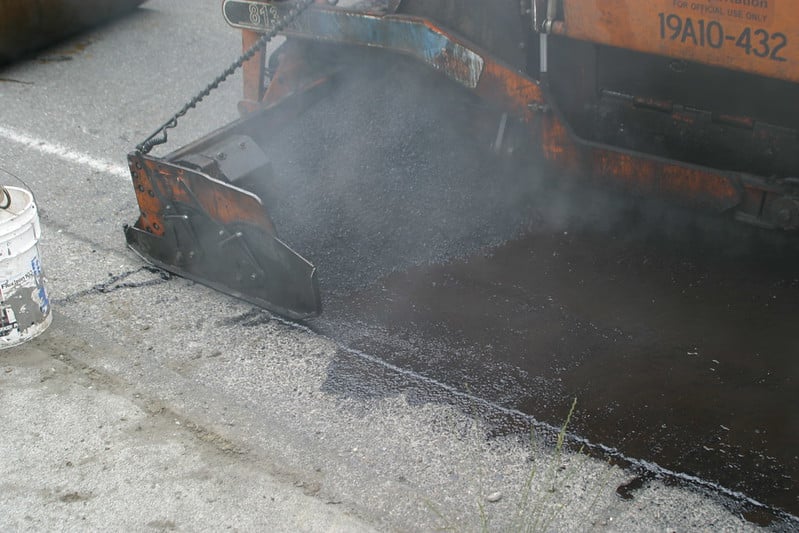
“There’s ongoing work to develop binders that can be mixed and applied at even lower temperatures,” said Soliman.”These advancements are crucial for reducing the environmental impact of road construction.”
Building streets and highways that last longer will also reduce the carbon footprint, as there will be less need for major rehabilitation that would require the additional use of heavy equipment.
Grappling with climate change
“Climate change accelerates the rate of deterioration of roads and all other types of infrastructure,” said Shalaby.
The construction industry must adapt as global temperatures rise, especially since asphalt is particularly sensitive to temperature change.
Researchers are exploring more resilient binders that can withstand higher temperatures without deforming.
“If climatic conditions are changing, then we will need to use more expensive binders,” Shalaby said. “These advanced binders often incorporate polymers to enhance performance but come at a higher cost.”
Designing roads for the future
Looking at historical weather extremes is no longer reliable for planning how to protect infrastructure from future damage caused by climate change; however, Shalaby said engineers can still use that historical data to deduce possible trends about how the weather could change over the coming decades.
“There are several climate change scenarios, but they also depend on our efforts to transition away from fossil fuels and our ability to reduce carbon emissions on a global scale,” said Shalaby.
Soliman said that when it comes to climate change, engineers deal with two key aspects.
“There’s the gradual increase in annual air temperature, and then there are the changing weather patterns.”
These changes are particularly impactful in regions like Saskatchewan and Manitoba, where roads endure deep freezing conditions in winter followed by rapid thaws in spring.
“We see a lot of moisture soaking into the road structure,” said Soliman. “This weakens the road, making it susceptible to damage under heavy loads.”
As the changing climate conditions produce more extreme temperatures, damage to the prairie’s ageing roads increases. There will be more potholes, cracks, and base erosion.
“It is a snowballing problem. We must continue to develop innovative tools and adaptations to mitigate the impacts of climate change,” said Shalaby. “This can take the form of a thicker road base, improved drainage, and a road structure that can handle heavier and more frequent truck traffic. Obviously, these designs come with a higher price tag, and they need to be justified.”
Making an impact outside the lab
Soliman and Shalaby engage with government agencies and industry partners to translate their findings into real-world applications.
Soliman will sometimes approach governments to implement his ideas.
“Investment in construction is millions of dollars, so change doesn’t happen right away,” said Soliman.
He will work with a government department to try a new innovation on a small test section of the road to ensure that what was done in the lab can be replicated in the field. If it works, the application can be used on a wider scale.
Shalaby said governments sometimes want research done.
“They ask us to run certain tests or to provide some data for them or to study a certain problem,” he said.
However, implementing research into the wider construction industry can take a long time because transitioning to a new product or process can be expensive.
“Construction industry change is slow, but changes are happening,” said Shalaby.
He and Soliman want to improve road safety.
“That’s really the objective,” said Shalaby. “We have to maintain these roads in a better condition, and to do that, we have to use the best tools available to reduce lifecycle costs and to be able to use limited and constrained budgets better.”
Soliman said his work also ensures tax dollars are optimized.
“Here in Saskatchewan, you can make a road that will last for the design life without a single crack if you want to put 20 per cent of your budget into one road, but you can’t do that,” said Soliman. “The other roads would suffer from damage.”
He said instead, municipalities use lower quality materials to be able to build more roads over a shorter time, knowing there will be cracks that will need to be fixed over the years.
“Infrastructure is critical to our quality of life,” said Shalaby.
Research into road construction is a dynamic field where changes are happening constantly.
“There are a lot of questions that haven’t been answered yet,” said Shalaby.
Our Prairie stories matter too.
The Flatlander takes a closer look at the stories that unite us, and make us unique, in Saskatchewan and Manitoba.
Will you help us tell our stories?
Author